A hidden woodland garden in Cornwall, just minutes from Plymouth
Antony Woodland Garden is one of Cornwall’s most peaceful and least crowded gardens — a placeto slow down, explore, and reconnect with nature. Just a short ferry journey from Plymouth, it offers over 100 acres of woodland walks, seasonal planting, and quiet riverside views.
Whether you’re looking for a gentle woodland walk in Cornwall, a place for a family day out, or a garden rich in rare plants, Antony Woodland Garden offers space to wander at your own pace.

A Garden of International Plant Collections
Antony Woodland Garden is recognised as an International Camellia Garden of Excellence, one of only a few in the UK, and is home to the National Collection of Camellia japonica.
More than 600 varieties of camellias grow here, from delicate species such as Camellia tsaii to well-known groups including sasanqua, saluenensis, williamsii, reticulata and japonica.
Alongside this is a remarkable collection of around 250 magnolia varieties, as well as rhododendrons, azaleas and hydrangeas. Throughout the year, different areas of the garden come into focus, making it a rewarding place to visit in every season.
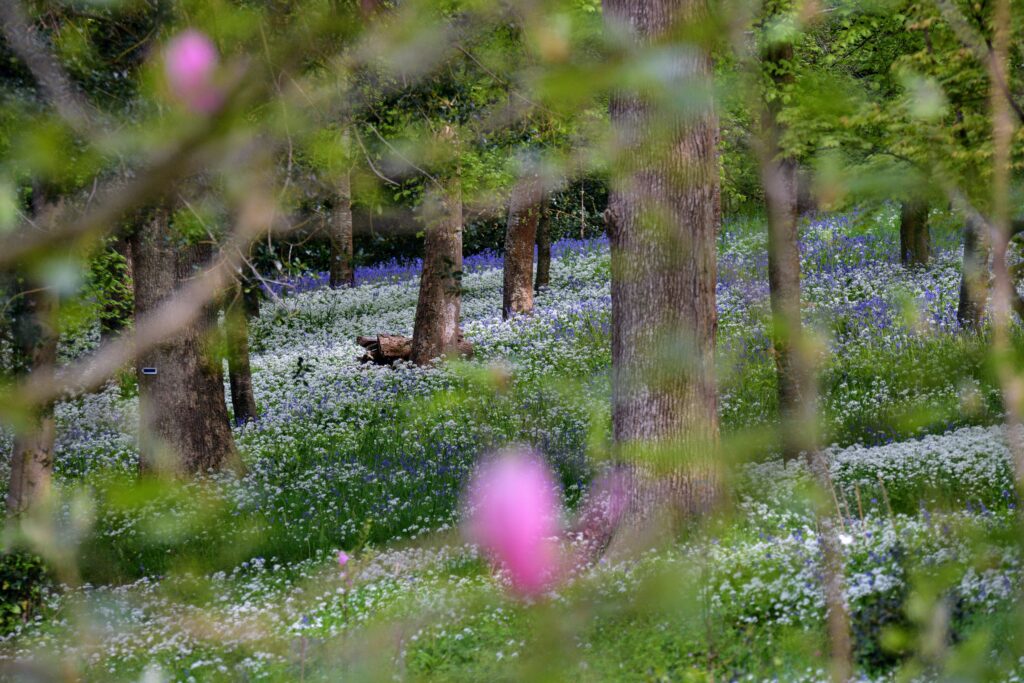
In spring, woodland glades are filled with wildflowers — bluebells, primroses, celandines, campion and wild garlic — creating one of the most natural displays of seasonal colour in Cornwall.
 Wildlife and the Lynher Estuary
The garden slopes down to the River Lynher, where woodland meets estuary. This rich environment supports a wide range of wildlife throughout the year.
Birds commonly seen include oystercatchers, grey herons, egrets, cormorants and shelducks feeding on the mudflats. Kingfishers are often spotted around the Bath House pond, while buzzards and kestrels circle overhead. Beneath the water, mullet move through the tidal creeks.
This combination of woodland, water and open space makes Antony Woodland Garden a particularly special place for nature lovers.
 The Wilderness
The Woodland Garden is made up of two distinct areas, the first of which is known as The Wilderness. Covering around 60 acres, this historic landscape leads down to the banks of the River Lynher.
The design dates from the late 18th century and reflects ideas developed by Humphry Repton, working in collaboration with Reginald Pole-Carew. Their vision is recorded in Repton’s “Red Book” for Antony.
Planting in The Wilderness was later developed by Lieutenant General Sir Reginald Pole-Carew, who introduced hybrid rhododendrons, and continued by Sir John Carew Pole, who expanded the collections to include camellias, magnolias and a wider range of ornamental shrubs.
 West Down Wood
West Down Wood forms the second part of the garden — a sheltered valley planted gradually from the late 1940s.
Here, evergreen camellias provide year-round structure, while magnolias rise above the canopy in spring, bringing colour and scale to the woodland setting. The planting style is naturalistic, allowing the landscape to feel both curated and unspoilt.
The two areas are linked by the Garden Field, where ornamental trees, flowering shrubs and seasonal bulbs create an open contrast to the surrounding woodland. A riverside path lined with silver birch completes the connection.

Woodland Walks in Cornwall
Beyond the formal garden lies a wider network of woodland walks along the River Lynher, offering a longer countryside route through woods and pasture.
The path leads to Fishful Pond, a historic tidal inlet believed to have been designed by Richard Carew as a fish trap. Today, it provides a valuable habitat for birds and wetland plants, including reed buntings.
From here, there are views across the River Tamar towards the Royal Albert Bridge, designed by Isambard Kingdom Brunel.
The walk continues past a badger sett, over a causeway and alongside the remains of a historic dovecote before returning to the garden entrance.
Well-behaved dogs are welcome on the Woodland Walk.
Plan Your Visit
Antony Woodland Garden is a place to visit more than once — with changing seasons, shifting light, and new details to notice each time.
Whether you come for the plant collections, the wildlife, or simply a quiet walk in Cornwall, you’ll find space here to explore, unwind and return to.